A Seat at Every Table: Gastrodiplomacy as a Cultural Asset, Economic Driver, and Regional Strategy in Ibero-America
by Daniela Tinajero Ortiz
Few diplomatic tools possess the rare ability to promote deeper cultural understanding, help preserve cultural heritage, encourage sustainable practices, stimulate economic growth, increase international tourism, and improve a country's standing in the global arena simultaneously. Gastronomy is one of them. Across Ibero-America, governments and international organizations are recognizing national cuisines as more than cultural expressions; they are leveraging them as strategic assets for sustainable development, highly relevant diplomatic languages, and powerful engines of economic growth.
The word "gastrodiplomacy" was first used in a 2002 TheEconomist article on Thailand's pioneering "Global Thai" initiative, which sought to promote Thai food abroad to attract tourists and strengthen international relations. Because of its incredible success, many similar programs were introduced all over the world; in consequence, the field of gastrodiplomacy evolved into a more formal analytical framework, with Paul Rockower being the first scholar to formally incorporate the concept into the field of cultural diplomacy and famously defining it as "the act of winning hearts and minds through stomachs". Yet the methods employed by different countries to achieve this objective vary just as much as their national identities do, and the effect of gastrodiplomacy has long extended beyond its original theoretical view as a soft-power-building strategy confined to middle-power states in the international system (Rockower,2012).
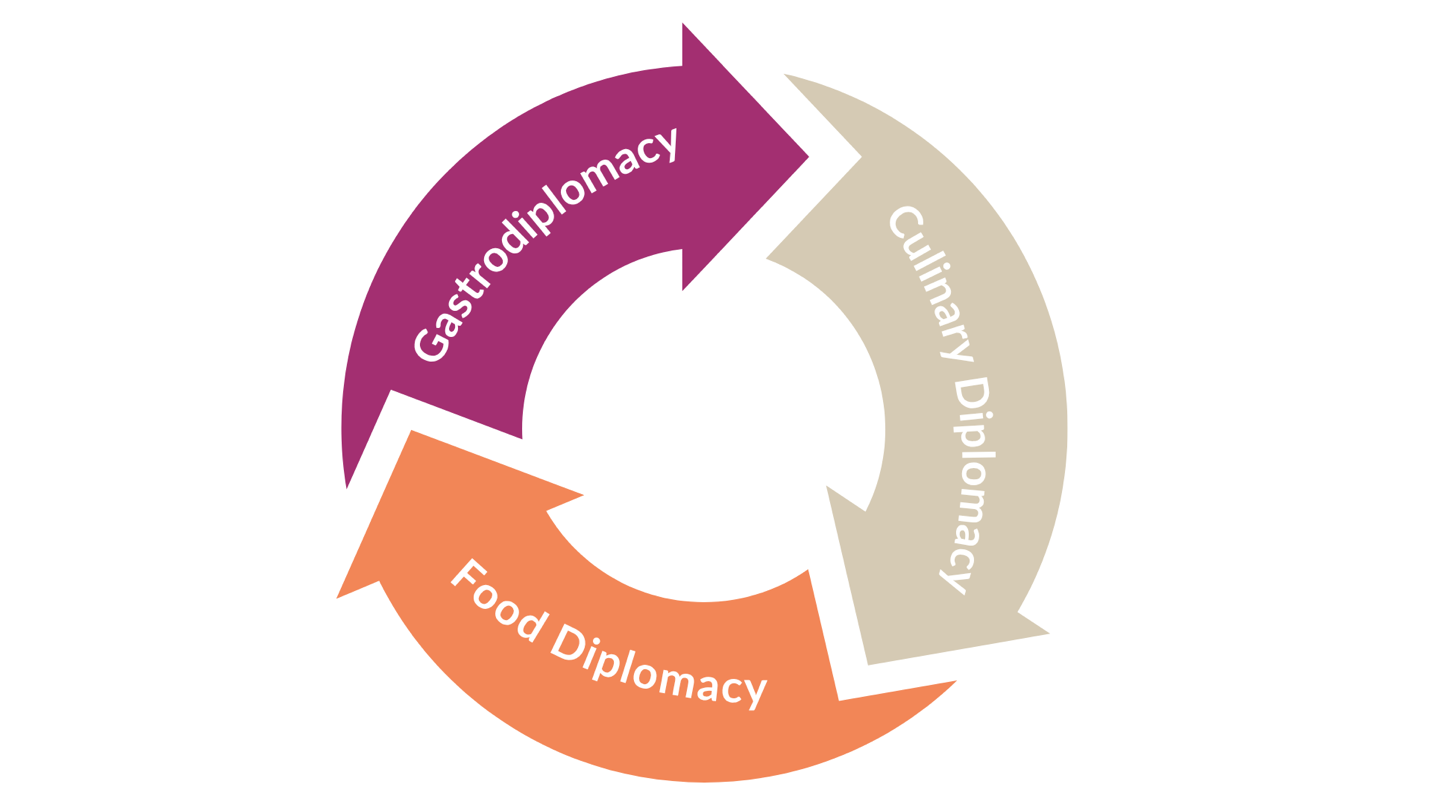
From its most traditional versions, such as state banquets and official diplomatic receptions, to more “pop culture-focused” iterations, like food travel vlogging (an emerging topic in gastrodiplomacy research), food has long played a central role in international relations between Ibero-American countries. To understand its influence today, I propose looking at all three “taste diplomacies,” an umbrella term used by Spanish and Portuguese authors Cabral, Lavrador, Orduna, and Moreira in a 2024 systematic literature review published in the International Journal of Gastronomy and Food Science. To provide epistemological clarity, they differentiate between 1) gastro-diplomacy, 2) culinary diplomacy, and 3) food diplomacy, and position them as the three most important pillars of leveraging food identities to create deep and prosperous international connections.
Gastrodiplomacy: Building a National Brand
It focuses on promoting national cuisines to foreign audiences, highlighting their importance to the nation's cultural identity (by combining foreign policy, public diplomacy, and, of course, cultural diplomacy). If it is successfully carried out, it enhances the country's international image and improves its chances of projecting a successful national brand, draws in tourism and investment, and contributes to economic growth and trade via agrifood exports.
At the beginning, countries in Ibero-America followed independent but, still, remarkably similar paths toward international recognition of their national gastronomy, frequently inspiring one another. Take the example of Peru and Mexico. With the launch of a state-backed campaign known as “Cocina Peruana para el Mundo” in 2006, Peru became the first Ibero-American country to build a national brand centered on its cuisine with the purpose of rebuilding the country's global image after decades of internal conflict (See Wilson, 2013). Mexico decided to take a more institutional route; and, a couple of years later, in 2010, it celebrated another type of first: the first time a country succeeded in inscribing its national cuisine (Lacocina tradicional mexicana: cultura comunitaria, ancestral y viva –El paradigma de Michoacán) in UNESCO’s Representative List of the Intangible Cultural Heritage of Humanity.
In the decade that followed, the diplomatic tables, quite literally, turned, and both countries’ gastrodiplomacy visions intersected. Peru achieved its own UNESCO inscription in 2023, with the recognition of the practicesand meanings associated with the preparation and consumption ofceviche as an expression of traditional Peruvian cuisine, and in 2025 Mexico launched “SelloM” , a state-operated certification scheme jointly managed by the Secretaría de Relaciones Exteriores and the Academia Mexicana de Gastronomía to promote authentic Mexican cuisine abroad.
Culinary Diplomacy: The Menu as Message
Representing a key element of diplomatic protocol strategy, culinary diplomacy refers to the use of official meals (state dinners, embassy receptions, international summits) to send a message of closeness or distance at the table, literally and metaphorically. Every detail matters (the venue, the menu, the protocol, who is seated where), and none of it is by chance. Also, it has a different focus than the previous form of “taste diplomacy,” since it is aimed at heads of state, ministers, and diplomats and not the general public.
Spain offers one of the clearest Ibero-American examples. Through state banquets hosted by the Spanish Royal Household and official diplomatic receptions, Spain showcases its regional products, wines, and culinary traditions as expressions of national identity and hospitality, underpinned by a remarkable gastronomic heritage, which includes 17 different regional cuisines (each one linked to one of the country's 17 autonomous communities), and more than 350 Protected Designations of Origin (PDO) and Protected Geographical Indications (PGI).
Food Diplomacy: Feeding Cooperation
Rather than supporting national branding, food diplomacy is concerned with the governance of the global food system (coordinating the networks that make humanitarian aid and development cooperation possible, or, on the other side of the spectrum, even addressing power imbalances that lead to the use of food as hard power in the international system). Multilateral organizations, like FAO, are one of food diplomacy’s main actors; by mechanisms such as multilateral agreements, technical cooperation, humanitarian relief operations, and trade policy, these institutions influence how complex food systems are approached and prioritized in the global arena.
Few Ibero-American countries have embraced food diplomacy as fully as Brazil. Building on the acclaim of its FomeZero (Zero Hunger) program, Brazil has positioned itself at the forefront in food security and social protection through South–South cooperation, institutionalized through the WFPCenter of Excellence Against Hunger in Brasília (2011). Rather than cuisine, Brazil leverages its agricultural and policy expertise to strengthen development partnerships and shape global debates on hunger and sustainable food systems.
PIGA 2030: A Regional Vision
The parallel direction of Iberoamerican countries I have described through this piece is not simply a trend; in the region, gastrodiplomacy has grown from separate national initiatives into a common regional language that has become, today, a full-scale regional strategy. This transformative change was finally realized with the creation of the Ibero-American Plan for Gastronomy and Food (PIGA 2030)
PIGA 2030 was adopted on December 15, 2020, under the Dominican Republic's Pro Tempore Secretariat of the Ibero-American Conference, and developed in response to the immediate need to enhance regional food resilience after COVID-19 pushed food insecurity to roughly 14 million people across Latin America and the Caribbean; the initiative links gastronomy with the UN2030 Agenda by means of two strategies: First, by viewing gastronomy as a multidimensional subsystem that connects agriculture, heritage, public health, tourism and economic development; second, by promoting traditional knowledge and culinary diversity in order to strengthen local value chains and speed up progress towards the Sustainable Development Goals. i.e., creating a collective infrastructure to boost both inter-sector and international cooperation. Coordinated by the Ibero-American General Secretariat (SEGIB), PIGA 2030 provides perhaps the most comprehensive framework so far for leveraging all three 'taste diplomacies' to their highest potential. Inside and outside the region.
That being said…
To me, there is something profoundly hopeful in watching a region united by centuries of shared history and culinary tradition choose to turn that heritage into a resilient infrastructure for co-creating an interconnected future; choose to build an ever-evolving framework that says to the world how much we believe in the power of multilateral cooperation and the importance of fostering the necessary collective will to govern food systems in the interest of all.
Let us think of the Ibero-American model of gastrodiplomacy when we need to remember that diplomacy is not built solely in conference rooms, but also cultivated in the ground, shared around dining tables, in local markets, and preserved through the traditions that communities pass from generation to generation.
If gastronomy has always earned nations a seat at the table, Ibero-America is proving why it has a leading voice in the conversation. We should all be listening.
About the author

Daniela Tinajero Ortiz
International Communication and Negotiation | Global Relationship Management
Daniela Tinajero
Ortiz studies how culture moves across borders — through trade, food, and
the rituals that bring people together.
A master's student in Global
& International Studies at the University of Salamanca (MGIS,
Global Business and Negotiation Track), her work sits at the
crossroads of international affairs, gastrodiplomacy, and the
economic ties that bind the Ibero-American world.