Can Nationalism Exist Without a Nation?
MGIS | Faculty and Students’ Research Publications
What makes a nation? A shared history, a common culture, a territory, or simply the belief that millions of people belong to the same community?
For centuries, political philosophers and social scientists have attempted to answer this question. Yet an equally important issue remains: Do the people who identify with a nation actually agree on what that nation represents?
This question lies at the heart of The Nation in Post-Neoliberal Buenos Aires, a research paper by political scientist Fernando López-Alves, presented within the academic context of the Instituto de Iberoamérica at the University of Salamanca.
Drawing on public-opinion research conducted in Buenos Aires, López-Alves challenges a longstanding assumption in the study of nationalism: that strong national sentiment necessarily reflects a shared understanding of national identity.
His findings suggest a more complex reality.
While citizens may express deep attachment to their country, their interpretations of what constitutes the nation can differ considerably. National identity, rather than representing a unified collective understanding, may be fragmented, contradictory, and deeply influenced by historical and political circumstances.
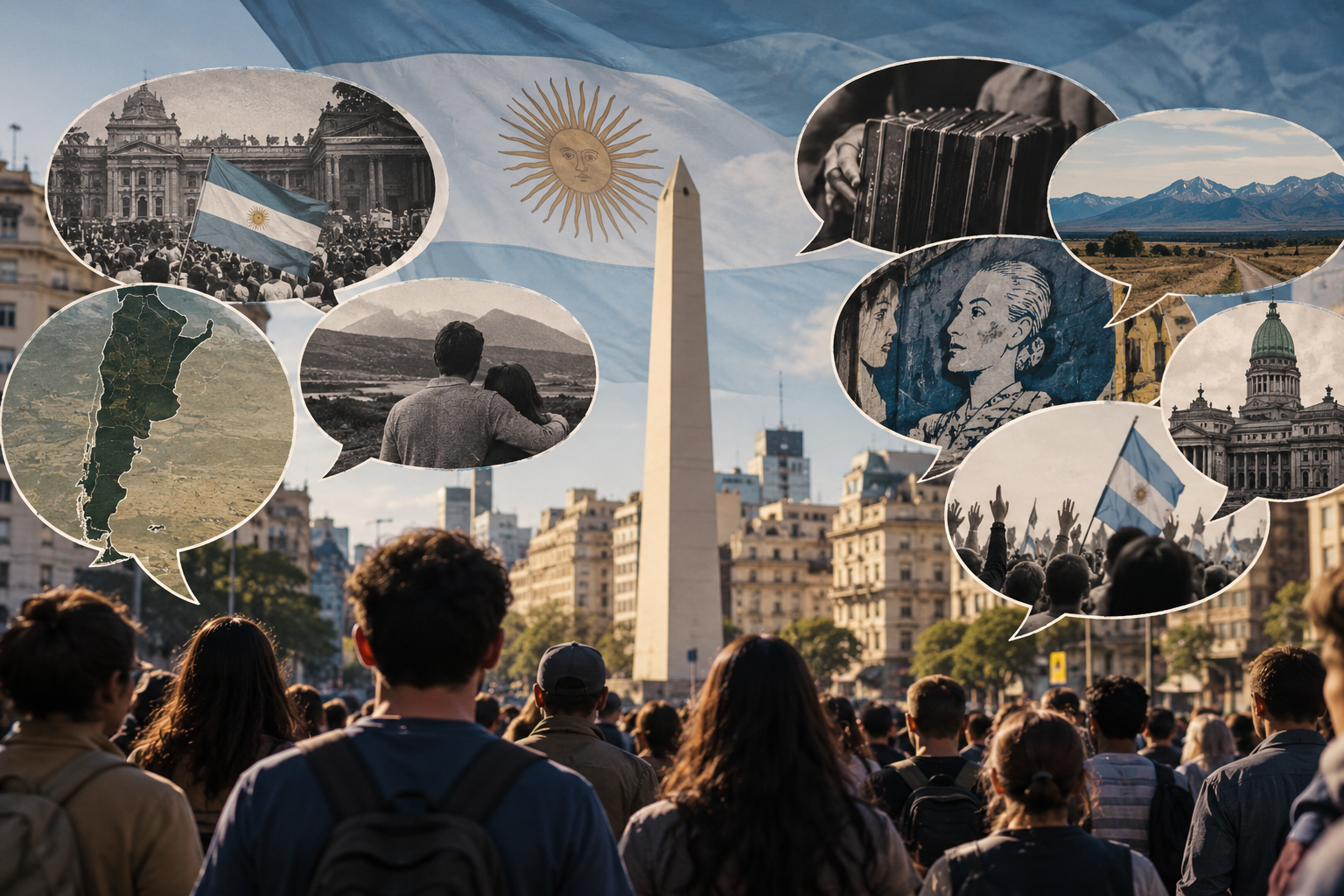
When Nationalism Does Not Require Consensus
Building on—and critically engaging with—the intellectual traditions of Ernest Renan, Max Weber, and Benedict Anderson, López-Alves examines the relationship between nationalism and the idea of the nation as an imagined community.
His research shifts attention from the narratives constructed by political leaders, intellectuals, and state institutions toward the perceptions of ordinary citizens.
Based on survey research involving approximately 1,400 respondents in Buenos Aires, the study reveals significant disagreement about the meaning of national belonging.
More than 60% of respondents were unable to provide a definite explanation of what the nation meant to them. Among those who offered an interpretation, definitions ranged from territory and cultural traditions to historical symbols, political institutions, and emotional attachment.
These findings raise a provocative question: If citizens cannot agree on what their nation is, what exactly unites them under the banner of nationalism?
López-Alves argues that nationalism may function as a powerful political and emotional force even without a widely shared conception of the nation itself.
The distinction has important implications for understanding political mobilization, state legitimacy, and collective identity.
Understanding National Identity Through Latin America
Although the paper concentrates on Buenos Aires, it forms part of a broader comparative research project examining national identity in Buenos Aires, Lima, and Montevideo.
The Argentine case is particularly significant given the profound economic, political, and institutional transformations experienced during the neoliberal reforms of the 1990s and the subsequent crises.
Rather than assuming that these transformations created fragmented national identities, López-Alves considers whether they intensified divisions with deeper historical origins.
His research also examines the relationship between territory, population, and national belonging, questioning whether a nation is primarily defined by its geographical boundaries or by the people who identify with it.
These issues remain central to contemporary debates about migration, diaspora communities, political polarization, and the changing relationship between states and societies.
A Contribution to the Study of Global Politics
Beyond its empirical findings, López-Alves's work invites scholars to reconsider the conceptual foundations of nationalism.
If nationalism can thrive without a coherent understanding of the nation, then national sentiment and national identity must be examined as distinct political phenomena.
This perspective contributes to broader debates in comparative politics, historical sociology, and international relations, particularly those concerning state formation, political legitimacy, and the construction of collective identities.
For the academic community of the Master in Global and International Studies (MGIS) at the University of Salamanca, the paper illustrates the value of combining theoretical inquiry with empirical investigation to challenge established interpretations of political and social phenomena.
It also demonstrates the continuing relevance of Latin America as a setting for examining questions that extend far beyond the region.
Ultimately, the research invites us to reconsider a fundamental assumption: perhaps what makes nationalism politically powerful is not necessarily a shared understanding of the nation, but the ability of different individuals to attach their own meanings to it.
About the Publication
Title: The Nation in Post-Neoliberal Buenos Aires
Author: Fernando López-Alves
Academic context: Instituto de Iberoamérica, University of Salamanca
Research areas: Nationalism, National Identity, Comparative Politics, Latin American Studies
This publication is revisited as part of the MGIS Faculty and Students’ Research Publications series, highlighting scholarly contributions that enrich discussions of global politics, international relations, and contemporary social transformations.