The Hidden Cost of AI Leadership: Why Rare-Earth Magnets Matter in the U.S.–China Technology Race
In a new analysis published by RealClearDefense, political and military analyst Carlo J.V. Caro examines how dependence on critical minerals could constrain America's strategic choices in artificial intelligence.
MGIS | Faculty and Students’ Research Publications
Artificial intelligence has become one of the defining arenas of technological competition between the United States and China. Much of the debate focuses on advanced semiconductors, computing power, and the race to develop increasingly capable AI systems.
Yet what happens when a country's ability to control the pace of technological development depends on something far less sophisticated than the technology itself?
In his article, America's Freedom to Slow AI Is Priced in Magnets, published by RealClearDefense on September 29, 2026, political and military analyst Carlo J.V. Caro examines an often-overlooked dimension of technological competition: the strategic vulnerabilities created by dependence on critical mineral supply chains.
His central argument challenges the assumption that technological leadership necessarily guarantees strategic autonomy.
A country may possess the world's most advanced technology while remaining dependent on another country for the industrial materials needed to sustain its economic and political choices. RealClearDefense
When Industrial Dependence Becomes Geopolitical Leverage
Caro opens his analysis with an episode that illustrates the relationship between industrial supply chains and technological competition.
In May 2025, Ford temporarily suspended production of its Explorer vehicles at a Chicago facility following disruptions in the supply of rare-earth magnets. China had introduced export restrictions on these materials the previous month.
Shortly afterward, Washington moved to resume exports of Nvidia's H20 artificial intelligence chips to China, having previously restricted their sale.
According to Caro, the connection between the negotiations over rare-earth magnets and the relaxation of chip restrictions illustrates a broader strategic vulnerability.
China's position within global critical mineral supply chains provides Beijing with leverage that extends beyond the industries directly dependent on those materials.
Restrictions affecting automotive manufacturing, for example, can create economic and political pressure capable of influencing decisions about advanced technology exports.
The implication is significant: technological competition is not determined exclusively by who develops the most sophisticated systems, but also by who controls the resources and industrial capabilities on which competing economies depend. RealClearDefense
The Two Clocks of Artificial Intelligence Competition
One of the most compelling elements of Caro's analysis is his distinction between two competing timelines.
The first concerns the technological race itself: how quickly China might narrow the gap with the United States in advanced artificial intelligence.
The second concerns the political sustainability of the measures Washington employs to protect its technological advantage.
These timelines operate at very different speeds.
Developing frontier AI systems and maintaining a technological lead may require years of investment, research, and industrial development.
Trade restrictions, however, can become politically difficult to sustain within weeks when another country responds by disrupting strategically important supply chains.
This creates a dilemma for policymakers considering whether to slow frontier AI development to allow more time for safety research and evaluation.
Such a strategy depends not only on maintaining technological superiority but also on preserving the political and economic conditions that make restraint possible.
Caro argues that a credible AI strategy must therefore consider the durability of the industrial and trade policies supporting it.
China's Strategic Position in Critical Minerals
Rare-earth elements occupy an increasingly important position in the global economy.
They are essential inputs for powerful permanent magnets used in electric vehicles, industrial machinery, advanced electronics, and defense technologies.
Their strategic significance extends beyond the availability of raw minerals.
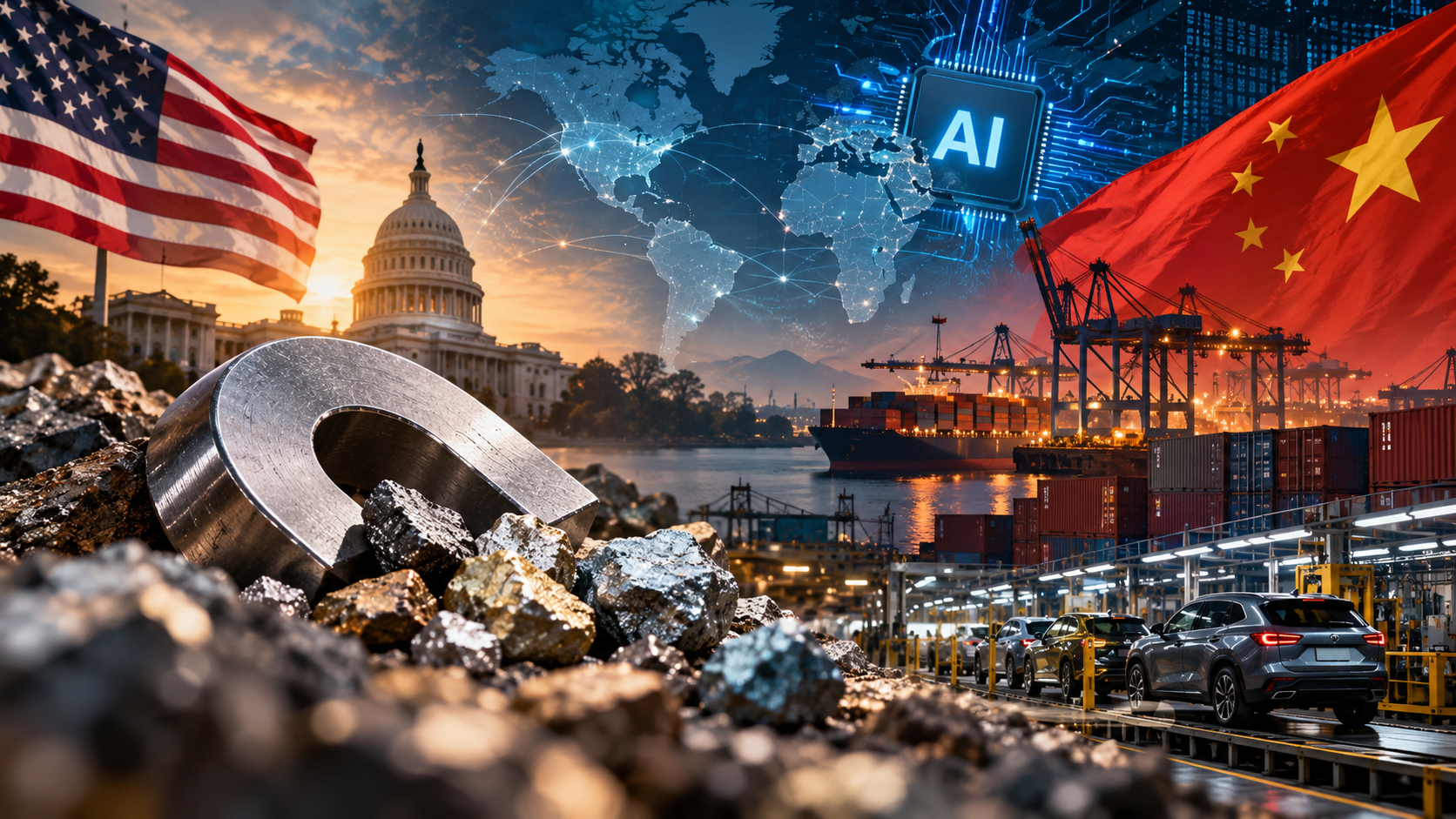
Citing International Energy Agency figures for 2024, Caro notes that China accounted for approximately 60% of mining, 91% of separation and refining, and 94% of sintered permanent-magnet production in the relevant rare-earth supply chains.
These figures illustrate a crucial distinction between possessing natural resources and controlling the industrial processes required to transform them into usable components.
Developing new mines outside China is only one part of the challenge.
Countries must also establish processing facilities, specialized manufacturing capabilities, qualified suppliers, and reliable delivery networks.
Consequently, reducing strategic dependence requires rebuilding entire segments of industrial supply chains rather than simply securing access to mineral deposits.
For Caro, this represents a fundamental challenge to conventional understandings of technological sovereignty. RealClearDefense
Can Strategic Stockpiles Protect Technological Autonomy?
The article also examines American initiatives intended to strengthen industrial resilience.
Among these is Project Vault, a strategic reserve initiative designed to improve access to critical materials for domestic manufacturing.
Caro acknowledges the importance of such investments while questioning whether accumulating raw materials is sufficient to protect industries against supply disruptions.
A strategic reserve, he argues, must be evaluated according to its ability to sustain actual production.
Possessing substantial quantities of rare-earth materials provides limited protection if manufacturers lack the facilities, equipment, or qualified suppliers needed to transform those materials into usable components.
The distinction is particularly important when considering the time required to develop alternative production capacity.
New industrial facilities may improve long-term security, but they cannot necessarily address a shortage affecting manufacturers today.
This creates a dual policy challenge: establishing immediate mechanisms to withstand supply disruptions while investing in the industrial infrastructure needed to reduce future dependence.
Rethinking National Security in the Age of AI
Beyond the specific question of rare-earth magnets, Caro's analysis raises a broader issue about the changing relationship between economic interdependence and national security.
Technological leadership is frequently discussed in terms of research capabilities, scientific innovation, access to advanced computing infrastructure, and investment in emerging industries.
However, these advantages exist within complex international production networks.
Dependencies involving raw materials, specialized components, industrial processing, and manufacturing capacity can become instruments of geopolitical influence.
Caro consequently advocates evaluating technological and industrial vulnerabilities together.
His proposed approach includes assessing how export restrictions might perform under different competitive scenarios and examining whether essential industries could continue operating during deliberate supply disruptions.
The objective is not simply to predict how technological competition will evolve, but to understand whether governments can sustain their strategic policies when economic pressure intensifies.
The article also raises questions about how the costs of strengthening supply-chain resilience should be distributed among governments, manufacturers, and technology companies.
These questions connect industrial policy directly to national security, international political economy, and the governance of emerging technologies.
Why This Analysis Matters for Global and International Studies
Caro's article illustrates a central challenge in contemporary international relations: the growing difficulty of separating technological innovation from economic security and geopolitical power.
The competition surrounding artificial intelligence is not confined to laboratories, semiconductor manufacturers, or digital infrastructure.
It also encompasses the international distribution of natural resources, industrial capabilities, supply-chain dependencies, and political influence.
For the academic community of the Master in Global and International Studies (MGIS) at the University of Salamanca, the analysis provides a relevant perspective on the interconnected nature of technological competition, international security, and global political economy.
It also highlights why understanding emerging technologies requires more than examining their scientific capabilities.
The strategic implications of artificial intelligence depend equally on the international relationships, material resources, and industrial systems that sustain technological development.
As governments consider how to regulate, accelerate, or restrain increasingly powerful AI systems, Caro's analysis introduces an important consideration: the ability to choose a technological strategy depends partly on whether a country can withstand the economic pressures associated with that choice.
Ultimately, the article reminds us that technological sovereignty is not simply about possessing advanced technology. It is also about maintaining the political and industrial freedom to determine how that technology is developed and used.
About the Publication

Original article: America's Freedom to Slow AI Is Priced in Magnets
Author: Carlo J.V. Caro
Published: September 29, 2026
Publication: RealClearDefense
Research areas: International Security, Artificial Intelligence, Geopolitics, Critical Minerals, U.S.–China Relations, Industrial Policy
About the author: Carlo J.V. Caro is a political and military analyst with graduate education at Columbia University. His work addresses international security, strategic competition, and foreign policy.
Read the original article:
America's Freedom to Slow AI Is Priced in Magnets — RealClearDefense
This MGIS feature presents and discusses the central arguments of Caro's analysis. The original article was published by RealClearDefense.